


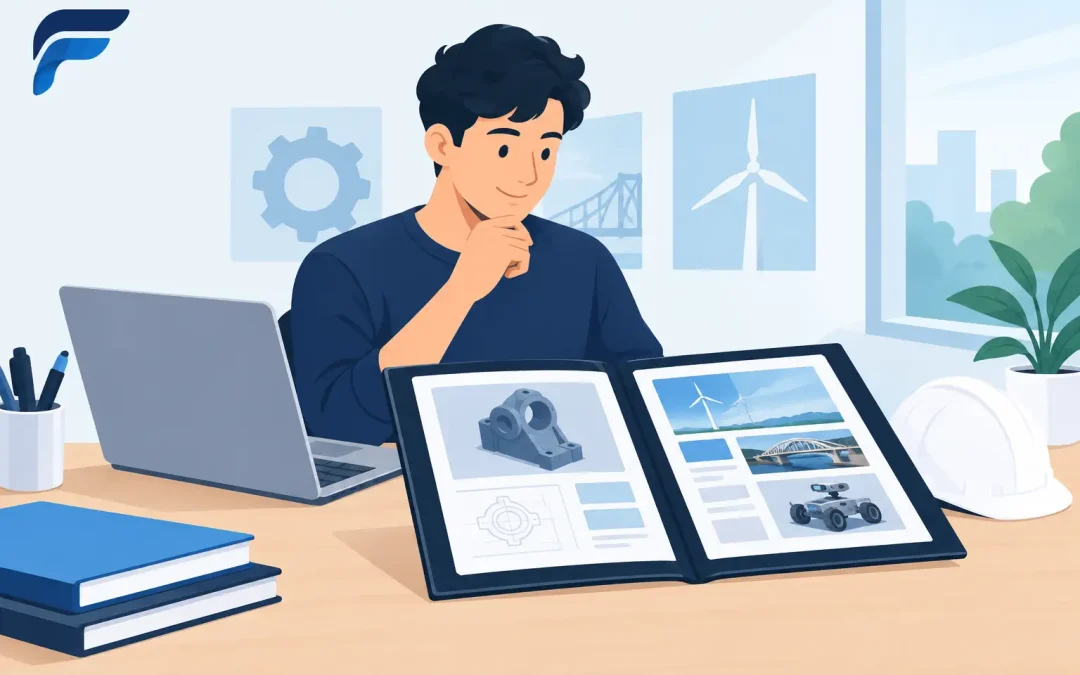
A portfolio can turn a Formula Student brake assembly, a battery-management algorithm, or a suspension test into proof that you are ready for serious engineering work. The best student engineering portfolios do not simply show what was built. They show how an engineer thinks when requirements conflict, time is short, and the result has to work.
For students entering motorsport, automotive, mobility, or advanced technology, that distinction matters. Recruiters, judges, sponsors, and technical mentors may only spend a few minutes with your work. Give them a clear reason to remember you: a real challenge, your specific contribution, the decisions behind it, and evidence that your solution performed.
What the Best Student Engineering Portfolios Prove
A strong portfolio is not a visual archive of every CAD model, workshop photo, or class assignment. It is a focused technical story. Each project should answer four questions quickly: What was the problem? What was your responsibility? How did you make decisions? What changed because of your work?
This applies across disciplines. A mechanical engineer might explain how a redesigned upright reduced mass while meeting stiffness targets. An electronics student might show how sensor filtering improved data quality. A business or operations lead might demonstrate how a purchasing system reduced delivery risk before a competition deadline. The project changes, but the evidence of ownership should remain clear.
Technical work is collaborative by nature, especially in a student racing team. Saying “we designed the car” is true, but it does not tell a reader what you did. The strongest portfolios make individual contribution visible without minimizing the team that made the project possible.
Start Every Project With a Clear Engineering Claim
Before collecting images or building a website, write one sentence that defines the value of each project. For example: “I developed and validated a cooling duct that kept inverter temperatures within the team’s operating target during endurance simulation.”
That claim gives the page direction. It also prevents a common problem: portfolios that begin with impressive visuals but leave the reader guessing about the engineering challenge. A clean render is useful, but it is supporting evidence, not the story.
Give the reader context before detail
Set up the project in a short opening paragraph. Explain the system, the constraint, and why the problem mattered. For a Formula Student project, this might involve rules compliance, packaging limits, driver safety, manufacturability, thermal performance, cost, or reliability.
Then state your role precisely. Use language such as “I owned the test plan,” “I designed the mounting interface,” or “I led the migration of the telemetry pipeline.” If responsibilities shifted during the season, say so. Honest scope builds more trust than inflated claims.
A reader should understand the project even if they have never seen your car, your university, or your team structure. Avoid unexplained acronyms and internal nicknames. Technical language is welcome when it clarifies the work, not when it creates a barrier.
Show the Process, Not Only the Finished Part
Engineering credibility lives in the decisions between the first idea and the final result. Include early concepts, calculations, simulation snapshots, test fixtures, manufacturing drawings, code excerpts, or comparison tables when they reveal how you worked.
You do not need to publish confidential files or every calculation. Select the moments that show judgment. Why did you choose a bonded joint over fasteners? Why was a lighter material rejected? Why did you change a control strategy after testing? A portfolio becomes memorable when it reveals the trade-offs behind the final answer.
Let constraints make the story stronger
Student projects rarely have unlimited budget, time, equipment, or access to suppliers. Those constraints are not weaknesses to hide. They often show the most valuable engineering behavior.
If a part had to be machined on campus, explain how that affected geometry and tolerances. If your team could not run a full-track test, explain the bench test or model used to reduce uncertainty. If a supplier delay forced a redesign, show how the team protected the larger vehicle schedule. Practical problem-solving is exactly what many employers want to see.
Be careful not to present every workaround as a success. If a solution had limits, state them and explain what you would improve in the next iteration. Reflection signals maturity. It shows that you can learn from data rather than defend every first decision.
Make Validation Visible
A portfolio without results can feel like a proposal. Whenever possible, show how you checked whether the work met its goal. Validation can take many forms: finite element analysis compared with a physical load test, dyno data, thermal measurements, code coverage, lap-time simulation, manufacturing inspection, driver feedback, or cost tracking.
Numbers help when they have context. “Reduced weight by 12 percent” is more meaningful when the reader knows the component, baseline, and requirement. “Improved reliability” becomes persuasive when paired with fault rates, test duration, or a clear before-and-after observation.
Not every student project produces perfect results. That is normal. A failed test can be one of the best pieces of portfolio evidence if you explain what it exposed and what changed next. Engineering is not a highlight reel. It is a disciplined cycle of hypothesis, test, revision, and verification.
Explain Teamwork Like an Engineer
Formula Student is built by multidisciplinary teams, and your portfolio should reflect that reality. Describe the interfaces that affected your work: the chassis team that needed a packaging decision, the electrical team that required a mounting location, the manufacturing lead who flagged an impractical tolerance, or the business team working around a sponsor commitment.
This is more than a soft-skills section. Interface management is technical work. A brilliant component that cannot be manufactured, serviced, integrated, or inspected is not a finished engineering solution.
Credit teammates by function where appropriate, especially when a result depended on shared work. At the same time, be direct about your own decisions and deliverables. The goal is to show that you can lead a defined task while contributing to a larger system.
Curate Fewer Projects With Better Evidence
Three strong projects usually outperform ten shallow ones. Choose work that represents range and direction. A mechanical student might include a vehicle subsystem, a manufacturing project, and a data-driven test project. A software student could pair embedded controls work with telemetry analysis and a user-facing tool for the team.
Each project page does not need the same length. A flagship Formula Student project may deserve a detailed case study, while a smaller course project can be concise. What matters is consistency: every page should establish the challenge, role, approach, and outcome.
For visual structure, use a small set of clearly labeled assets rather than a crowded gallery:
- one image that shows the finished system in context
- one technical artifact, such as a drawing, simulation, schematic, or code diagram
- one image or chart from testing or validation
- one short result panel with measurable outcomes and lessons learned
This format respects a reviewer’s time while giving technically curious readers a path into the details.
Build for the Reader Who Has Five Minutes
Your portfolio should work on a phone as well as a laptop, load quickly, and make your name, discipline, and contact details easy to find. A simple site is often enough. If you use a PDF, make it readable without zooming into tiny drawings and avoid pages packed with text.
Put your strongest project first. Include a brief introduction that states the kind of engineering work you want to do, not a generic statement about being passionate. Passion is visible in the quality of the work. Direction is more useful: vehicle dynamics, embedded systems, battery technology, composite design, manufacturing, data acquisition, or technical project management.
Before sharing it, ask a teammate from another subsystem to review it. If they cannot explain your role and result after five minutes, improve the structure. Then ask a technical mentor whether your claims are precise enough. Those two perspectives catch different problems.
At FS Alpe Adria, teams meet people who understand that a race car is never the product of one discipline or one late night in the workshop. Build a portfolio that carries that same spirit: ambitious enough to show what you can do, honest enough to show how you learned, and clear enough to start the next conversation.