


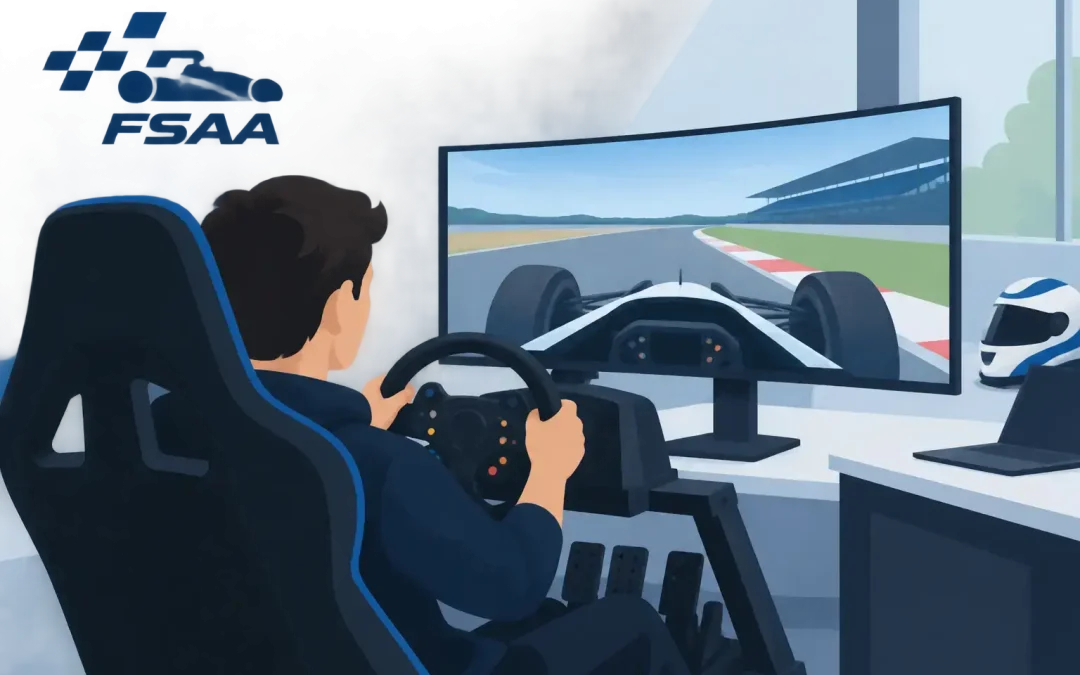
A driver arrives at the braking point too late, locks the unloaded front tire, and loses two tenths before the apex. In a physical car, that mistake can cost tire life, track time, and a valuable test day. In a simulator, it becomes a repeatable lesson. This racecar simulator review looks at what simulation can genuinely deliver for Formula Student teams, where it falls short, and how to judge whether a platform deserves space in your development program.
For student engineers, simulation is not just a way to keep drivers engaged between events. Used with purpose, it can connect vehicle dynamics theory, data analysis, setup decisions, and driver feedback before the car reaches the test track. Used carelessly, it can create confidence in a car model that has never met reality.
What a Racecar Simulator Review Should Measure
The best simulator is not automatically the one with the sharpest graphics, the biggest catalog of famous circuits, or the most expensive motion platform. A Formula Student team should evaluate it against the work it needs to support: learning a circuit, developing a driver, checking a setup direction, testing control logic, or building a repeatable data workflow.
Start with vehicle behavior. Does the platform allow meaningful adjustment of mass distribution, suspension geometry, tire characteristics, aerodynamics, differential settings, power delivery, and regenerative braking? A useful simulator does not need to perfectly reproduce every bushing or airflow detail. It does need to respond logically when an engineer changes a parameter. If a stiffer rear anti-roll bar, revised brake balance, or altered torque map produces behavior that contradicts basic vehicle-dynamics expectations, it is a weak engineering tool regardless of how convincing it feels from the cockpit.
Tire modeling deserves especially close attention. Tires define much of a formula-style car’s behavior, yet their grip changes with load, temperature, pressure, camber, slip angle, and surface condition. Many consumer-focused simulators create an enjoyable driving experience without offering enough transparency for engineering work. That can still make them valuable for driver practice, but teams should not treat them as a virtual wind tunnel or a replacement for tire testing.
The second measure is data. Engineers need more than a lap time and a replay. Look for telemetry channels that can support real questions: steering angle, wheel speeds, brake pressure, throttle position, yaw rate, longitudinal and lateral acceleration, damper travel, tire temperatures, motor power, energy use, and GPS-based track position. Exportable data matters because analysis should happen in the tools your team already understands, not only inside a dashboard designed for entertainment.
A platform becomes far more useful when a driver can say, “The rear became unstable on entry,” and the vehicle-dynamics group can examine brake trace, steering rate, yaw response, and wheel-speed behavior to understand why. That conversation is where virtual laps become engineering education.
Realism Has More Than One Layer
Simulator realism is often discussed as if it were one score. It is better understood as several connected layers: physics, controls, visual reference, feedback, and process realism.
Physics is the foundation, but controls shape what the driver can feel. A direct-drive wheel with a rigid cockpit and properly adjusted pedals can reveal load buildup, understeer, and rear instability much more clearly than an entry-level wheel mounted to a flexible desk. Load-cell brake pedals are particularly valuable because they reward pressure control rather than pedal travel. That better reflects the braking discipline required in a race car.
Motion systems can add immersion, but they are not a first priority for every team. A well-configured static rig with reliable force feedback, good pedals, and useful telemetry often produces more development value than a costly motion system paired with a generic car model. Motion can help drivers recognize cues, yet it cannot compensate for inaccurate tire behavior or poor data access.
Visual realism also has limits. Laser-scanned tracks and high-detail environments help drivers learn landmarks, elevation changes, and corner rhythm. But Formula Student events often take place on compact autocross-style layouts rather than permanent circuits. For that reason, the ability to create, import, or closely reproduce a course may matter more than access to a famous international track.
The final layer is process realism. Can your team define a test objective, make one change at a time, log the result, and decide what to investigate next? If the simulator encourages random setup changes until a fast lap appears, it trains habits that do not transfer well to the paddock.
Where Simulators Deliver the Most Value
Driver development is the clearest return. New drivers can learn vision, braking consistency, steering discipline, throttle application, and recovery from mistakes without consuming tires or risking hardware. Experienced drivers can practice a sequence of corners, compare techniques, and develop a common language with engineers. The gain is not simply faster laps. It is more precise feedback.
Simulators are also strong tools for familiarization. Before an event, a team can build a reference for corner numbering, likely braking zones, and the rhythm of a course. If the digital layout is approximate rather than exact, be honest about that limitation. The goal is preparation, not false certainty.
For engineering, simulation is most valuable when used for directional work. It can help test whether a setup change is likely to shift balance toward entry understeer or exit oversteer. It can expose the trade-off between peak grip and controllability. Electric teams can use virtual work to discuss torque-vectoring behavior, pedal maps, energy strategy, and regenerative-braking feel before committing to track tests.
At FS Alpe Adria, where students bring design, software, business, and driving disciplines together at the Bugatti Rimac Test Track, that shared learning is a real advantage. A simulator session can give controls engineers, vehicle-dynamics students, and drivers a reason to solve the same problem together rather than work in parallel.
The Limits That Good Teams Respect
A virtual model is only as credible as its assumptions. If the car’s real mass, center of gravity, tire data, damping curves, aero map, or powertrain response are uncertain, the simulation result should be labeled as an estimate. That is not a failure. It is a disciplined way to identify what the team needs to measure next.
Track conditions are another major gap. Wind, pavement variation, tire pickup, ambient temperature, driver fatigue, and the pressure of a timed run all affect a real event. A simulator can train the mind and support engineering decisions, but it cannot fully recreate the stakes of standing in the queue for an autocross run with one opportunity to execute.
There is also a people challenge. A simulator often becomes the responsibility of one enthusiastic member who understands the software but does not share results with the wider team. Avoid this by treating simulator work like any other test activity. Set an objective, record the configuration, identify the driver, store the data, and hold a short debrief. The result is a growing knowledge base instead of isolated fast laps.
Choosing the Right Simulator Setup
The right choice depends on your current maturity. A newer team may gain the most from a dependable rig that improves driver consistency and introduces telemetry review. A more established team with validated vehicle data may justify a deeper integration effort, including custom vehicle models and software-in-the-loop testing.
Before buying hardware or committing to a platform, ask four practical questions:
- Can we use it repeatedly throughout the season, not only during recruitment?
- Can drivers and engineers access data that supports a specific decision?
- Can we model or approximate the cars and courses relevant to our program?
- Do we have people assigned to maintain the rig, model updates, and session documentation?
Budget for the full system, not only the wheelbase. A stable chassis, adjustable seating position, dependable computer, pedals, display, data storage, and calibration time all influence the result. A modest setup that is available every week can outperform an ambitious setup that remains unfinished in a workshop corner.
Turn Virtual Laps Into Better Track Days
The strongest teams connect simulation to a simple feedback loop. Start with a question such as whether a new brake map makes threshold braking easier to repeat. Run controlled virtual sessions with the same driver and configuration. Review the telemetry, capture the driver’s comments, then take the most useful hypothesis to physical testing. After the track day, compare what happened with what the simulator suggested and update the model or the team’s confidence in it.
That loop protects teams from a common mistake: treating simulation as a prediction machine. Its better role is to make testing more intelligent. It helps narrow the questions, prepare the people involved, and reveal where real-world measurement is still needed.
A simulator will not build a competitive Formula Student car by itself. The students who use it to ask sharper questions, communicate across disciplines, and arrive at testing better prepared will build the advantage that matters.