


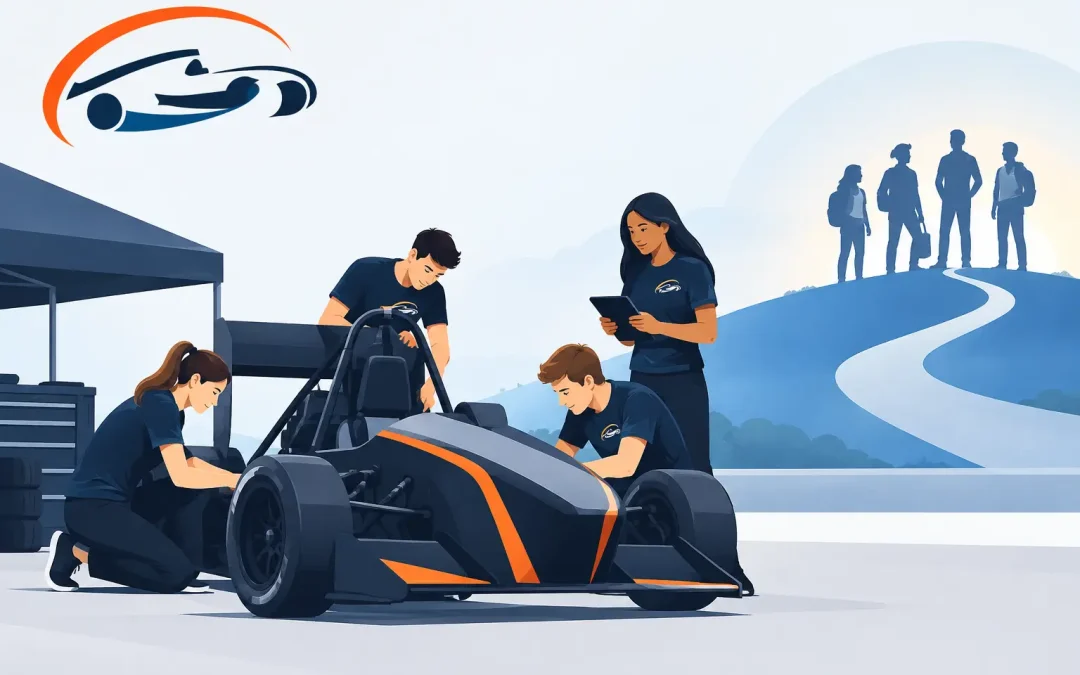
A Formula Student car is never just a car. It is the visible result of late-night design reviews, failed tests, cost decisions, sponsor conversations, and dozens of people learning how to deliver under pressure. That is why Formula Student careers carry real weight with employers. They show that a student has moved beyond solving an assignment alone and has helped build a working engineering project with a deadline, a budget, and a team depending on them.
For students aiming at automotive, motorsport, mobility, software, manufacturing, or product-development roles, Formula Student can become the strongest part of a portfolio. The competition does not replace a degree, internship, or technical fundamentals. It gives those things context. It turns knowledge into evidence.
Why Formula Student careers stand out
A recruiter may see hundreds of candidates who have taken similar courses. What separates one candidate is usually not a longer list of software tools. It is proof of judgment. Can they define a problem, make a trade-off, communicate with different disciplines, test an idea, and explain what happened when the result was not what they expected?
Formula Student creates those moments constantly. A chassis member may need to be lighter without compromising safety. A battery enclosure must satisfy demanding technical requirements while remaining practical to manufacture and service. A vehicle dynamics decision can improve one aspect of performance while creating a new tire, packaging, or reliability challenge. Students learn quickly that engineering is rarely about finding one perfect answer.
That experience is valuable well beyond race cars. An aerospace supplier, robotics company, EV startup, industrial manufacturer, or technology business all need people who can work through uncertainty without losing sight of the requirements. The project may change; the habits travel.
There is also a difference between saying you were part of a team and explaining your contribution to a team. Formula Student gives students specific stories: the test that revealed an unexpected issue, the design review that changed a plan, the sponsor meeting that secured an essential resource, or the presentation that made a business case credible. Those stories are what make interviews memorable.
Build career evidence, not just a title
A team role can sound impressive, but a title alone does not tell an employer much. The strongest candidates can describe the scope of their work, the decisions they made, and the outcome. A suspension lead who can explain load cases, validation methods, and the next improvement has more to show than someone who simply lists suspension on a resume.
Start by keeping a record while the season is still happening. Document your design targets, calculations, simulations, drawings, test plans, manufacturing decisions, and final results. Save before-and-after data where possible. If a component failed, record the root cause and the corrective action. If the data was incomplete, explain how your team made a responsible decision anyway.
This is not about presenting a flawless project. Competitive engineering teams know that iteration is part of the work. A thoughtful account of what did not work can show maturity, especially when you can explain how the team responded. The key is ownership. Avoid vague phrases such as helped with the car. Be ready to say what you were responsible for, who you worked with, and what changed because of your work.
Your portfolio can be simple: a clean resume, a few carefully selected project pages or presentation slides, and visual evidence that is appropriate to share. Protect confidential sponsor information and respect your team’s internal rules. The goal is not to publish every drawing. It is to make your capabilities easy to understand.
Translate team work into employer language
Students often underestimate skills because they are so familiar with the work. Designing a wiring harness can demonstrate electrical architecture, requirements management, documentation discipline, fault finding, and manufacturing coordination. Preparing the cost report can demonstrate supplier research, financial awareness, component tracking, and clear communication. Running social media or partnerships can show brand thinking, stakeholder management, sales confidence, and event execution.
The translation matters because Formula Student teams are multidisciplinary by nature. A mechanical engineering student may discover an interest in data acquisition. A software student may become fascinated by controls. A business student may find a path into technical project management or motorsport partnerships. Do not force your experience into a job title that does not fit. Explain the capability you developed and the problem you want to solve next.
Technical excellence needs teamwork
The most capable teams do not operate as isolated departments. Aerodynamics affects cooling, packaging, mass, and manufacturability. Electronics affects testing, safety, driver feedback, and reliability. Business and sponsorship work affect what the team can actually build. Every subsystem has a technical purpose, but every subsystem also depends on people sharing information early enough to act on it.
That is where Formula Student develops an advantage that is hard to reproduce in a classroom. You learn how to bring evidence to a meeting, ask better questions, and disagree productively. You learn when to defend a requirement and when to adjust a design because another constraint is more important. Those are professional skills, not extras.
Leadership is part of this too, and it is not reserved for team captains. A first-year member who organizes a useful test log, trains new manufacturing members, or makes a meeting more focused is practicing leadership. The same is true for someone who helps a teammate understand a technical concept rather than keeping knowledge locked inside one department.
Employers notice this because projects fail when communication fails. A candidate who can contribute technically and make the people around them more effective brings a different level of value.
Use the competition community with purpose
Formula Student events put students in the same environment as judges, scrutineers, volunteers, sponsors, alumni, and teams from other universities. That access is powerful, but networking is not collecting the most contacts in a day. It is building a reputation for curiosity, preparation, and respect.
Talk to people about the work. Ask a scrutineer what commonly causes teams trouble in a technical area you care about. Ask an experienced engineer which skills their team needs most. Speak with another student team about a solution you admire and the compromise behind it. Then listen carefully. A useful conversation can lead to practical advice, a future collaboration, or a clearer view of the kind of role you want.
At FS Alpe Adria, the competition environment at the Bugatti Rimac Test Track makes that exchange especially tangible. Cars, data, inspections, dynamic events, and presentations all create natural opportunities to meet people through shared effort rather than forced introductions. Volunteers and technical experts are part of that community as well. Joining the event from another angle can broaden your perspective on how a professional competition is delivered.
Follow up after meaningful conversations. A short message that refers to a specific discussion is enough. Do not ask for a job immediately. Stay connected, share a genuine project update when appropriate, and let relationships develop over time. Knowledge is power, but network is the key to success when it is built on real contribution.
Choose depth before chasing every opportunity
Formula Student can open many doors, and that can create pressure to do everything: lead a subsystem, attend every event, learn every software package, apply for every internship, and take on every extra responsibility. That approach can lead to burnout and shallow work.
It is usually better to develop depth in one or two areas while staying curious about the wider vehicle. A student interested in controls should understand how their work affects the driver and the hardware around it. They do not need to become the team expert in composites, finance, and aerodynamic modeling in one season. Progress comes from focused responsibility, honest feedback, and repeated practice.
The right balance depends on your goals. Motorsport roles may reward highly specialized technical depth, while startups often value people comfortable moving across disciplines. Large manufacturers may look for structured processes and validation discipline, while smaller teams may prioritize speed, initiative, and practical problem solving. Formula Student helps you test these preferences before your first full-time role.
Turn each season into a stronger next step
At the end of a season, do more than celebrate the result. Review your own development. Which decisions are you proud of? Where did you lack knowledge or confidence? Did you spend enough time testing? Were you able to explain your work clearly to non-specialists? These questions can shape the courses, projects, internships, and responsibilities you pursue next.
A finished car is a milestone, not the finish line. Carry the lessons forward, stay generous with the knowledge you gained, and take on the next challenge with enough ambition to make your work matter.