


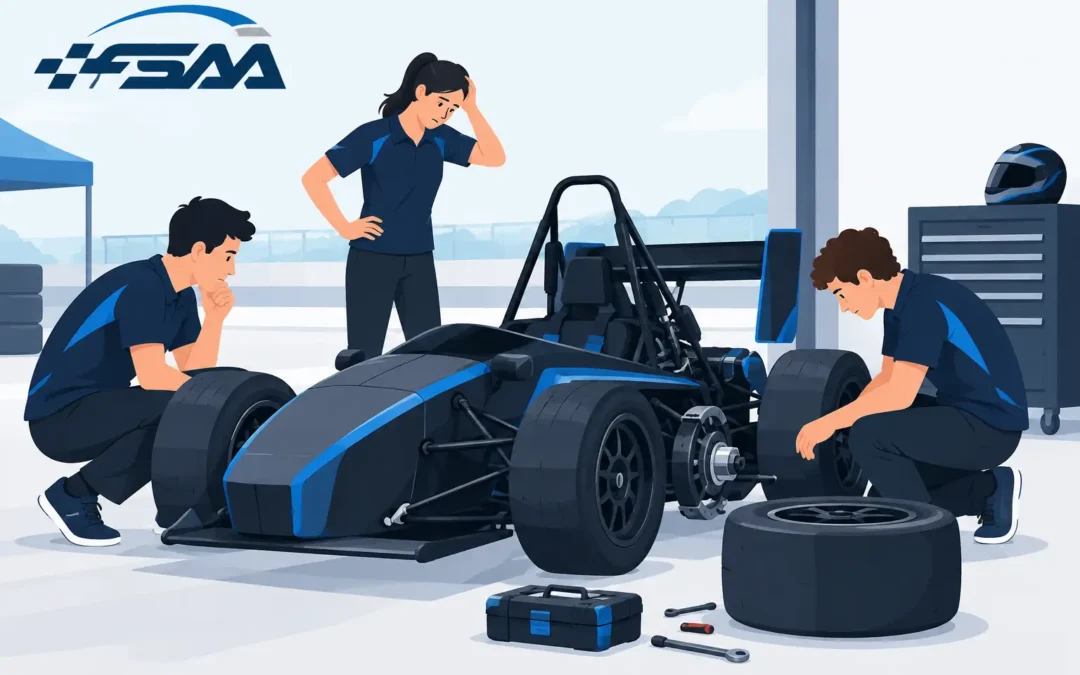
A car can look complete in the workshop and still be far from race-ready. The first power-on reveals a sensor issue. The first brake test exposes an air bubble. Technical inspection finds a rule conflict that requires a redesign with hours left. That is why do student racecars fail is a question every Formula Student team should ask early, not after loading the trailer.
Failure is rarely one dramatic mistake. More often, it is the accumulated result of small decisions made without enough time, ownership, data, or communication. The encouraging part is that these patterns are visible. Teams that learn to spot them can turn setbacks into a stronger car, a stronger organization, and a better competition experience.
Why Do Student Racecars Fail? The Real Meaning of Failure
A student racecar does not have to crash to fail. It can fail by missing technical inspection, by being unreliable in dynamic events, by arriving without the documents needed to compete, or by presenting a business case that does not support its engineering decisions. A car that finishes one run but cannot repeat that performance may also fall short of its potential.
Formula Student raises the stakes because the vehicle is only one part of the project. Teams are evaluated on design, cost, business thinking, efficiency, handling, endurance, safety, and professionalism. A brilliant suspension concept cannot compensate for incomplete accumulator documentation. A powerful electric drivetrain means little if the car cannot pass scrutineering or complete endurance.
That is not a reason to lower ambition. It is a reason to define success as a complete, validated project rather than a collection of impressive components.
The Schedule Becomes More Dangerous Than the Design
Most teams do not start with too little talent. They start with an optimistic plan. A manufacturing delay looks manageable in November. A late supplier response feels recoverable in January. Then exams, budget approvals, workshop access, and integration work compress the remaining time until the team is building and debugging at once.
This is when a project becomes fragile. The final weeks are consumed by tasks that should have happened months earlier: making wiring looms, bleeding brakes, resolving software faults, creating spare parts, and producing documentation. Testing becomes a luxury instead of a planned engineering activity.
A useful rule is simple: set the internal car-complete date far before the event. Not visually complete. Not nearly rolling. Complete enough to begin real validation. The gap between car completion and competition is where teams find failures safely, learn from them, and build confidence.
Design Freeze Is a Commitment, Not a Suggestion
Late changes are sometimes necessary, especially when a safety issue appears. But casual changes after design freeze are expensive because they affect interfaces. A new sensor may require different mounts, wiring, software scaling, cooling assumptions, and validation procedures. One seemingly small adjustment can reopen five finished subsystems.
Teams need a clear process for changes: identify the reason, assess the impact, assign an owner, and decide whether the performance benefit is worth losing test time. This does not restrict innovation. It protects the car from innovation that arrives too late to prove itself.
Integration Is Where Good Subsystems Become a Bad Car
Student teams often organize around subsystems: chassis, aero, suspension, electronics, drivetrain, and business. That structure is practical, but the racecar does not operate in subsystems. It operates as one connected machine.
A cooling package may fit in CAD but interfere with service access. A wiring harness may be electrically correct but vulnerable to vibration and heat. An aerodynamic package may create downforce while making suspension adjustments difficult at the track. A software team can deliver excellent control logic, yet still struggle if sensor mounting, grounding, and connector selection were not agreed on early.
Integration needs owners, interface drawings, and regular physical checks. The car should be assembled progressively throughout the build, not for the first time near departure. Teams that fit real components to real mounts early discover the gaps that a digital assembly can hide.
Validation Arrives Too Late, or Not at All
The fastest student racecar is not necessarily the one with the highest predicted peak performance. It is the one whose behavior the team understands well enough to set up, repair, and drive repeatedly.
Validation starts with requirements. What must the brakes achieve? What temperatures are acceptable? What are the expected loads? What data will confirm that the car is functioning correctly? Without measurable targets, testing can become a series of laps with no clear learning outcome.
A mature test program moves from component checks to subsystem tests and then to vehicle-level running. Before the car sees a full dynamic session, teams should know that every fastener is secured, every safety circuit behaves correctly, every sensor reading is believable, and every critical system has a defined fault response. For electric vehicles, this discipline is especially vital around insulation, shutdown behavior, accumulator safety, and high-voltage procedures.
Track time should answer focused questions. Is brake balance stable as temperatures rise? Does the car reach expected wheel speeds? Are inverter temperatures rising faster than predicted? Is the driver able to repeat the same input? Data is valuable only when someone is responsible for reviewing it and turning findings into actions.
Reliability Is Designed Into the Details
Endurance rewards teams that respect unglamorous work. Connector strain relief, hose routing, heat shielding, fastener retention, labeling, access panels, and spare parts can decide whether a car finishes. These details rarely make the launch presentation, but they are often the difference between a repair measured in minutes and one that ends a run.
Reliability also requires realistic margins. A component selected exactly at its expected load or temperature limit may work in a spreadsheet and fail in a hot paddock. Student teams operate with changing drivers, limited test mileage, imperfect manufacturing, and unknown conditions. Conservative choices in critical areas can create more total performance by keeping the car on track.
The trade-off depends on the team. An experienced team with extensive validation may justify a more aggressive design. A newer team may gain more points and more learning by choosing a simpler architecture that can be tested thoroughly. Finishing is not a lack of ambition. It is a performance target.
People Problems Become Engineering Problems
A Formula Student car is built by students who are balancing classes, jobs, exams, and life outside the workshop. Knowledge can disappear when a graduating member leaves. Decisions can stall when responsibilities are unclear. A part may not be made because everyone assumed somebody else owned it.
The answer is not asking people to work endlessly. It is building a team structure that makes progress visible and knowledge transferable. Each critical task needs an owner, a deadline, and a clear definition of done. Design reviews should invite challenge without turning into blame. New members need enough context to contribute before the final month, not just a list of urgent tasks.
Documentation is part of this culture. A clean design rationale, manufacturing drawing, wiring diagram, test record, and setup sheet make the team faster next season. They also make it easier for mentors, scrutineers, and industry professionals to understand the quality of the work.
Treat Rules and Scrutineering as Engineering Inputs
Rules are sometimes treated as a final compliance exercise. That mindset creates expensive surprises. The rules define packaging space, safety architecture, documentation needs, test procedures, and many material choices. They belong at concept selection, not only at pre-event inspection.
Teams should review the relevant requirements whenever a design decision affects safety, structure, electrical systems, or vehicle operation. Just as important, they should practice explaining the car. Scrutineering is not only about having the correct part. It is about demonstrating that the team understands how the part works, why it is safe, and how it was verified.
At FS Alpe Adria, teams meet a community that recognizes both sides of the challenge: the pressure of competition and the long-term value of disciplined engineering. Prepare for that conversation early. A confident technical explanation is built in the workshop, not improvised in the inspection line.
Build a Team That Can Recover
Even well-managed projects encounter failures. A supplier misses a deadline. A part cracks. Rain changes the test plan. What separates resilient teams is their response. They avoid hiding bad news, isolate the problem, protect safety, collect evidence, and choose the next action without panic.
Create room for recovery before you need it. Keep realistic contingency in the budget, identify long-lead risks, manufacture critical spares when possible, and train more than one person on vital systems. After each test, record not just what broke but why the team did not detect the risk earlier. That question turns a repair into progress.
The goal is not to build a car that never exposes a weakness. The goal is to build a team capable of finding weaknesses while there is still time to act. Bring that mindset to every test day, design review, and workshop conversation, and race day becomes a chance to show what your team has earned.