
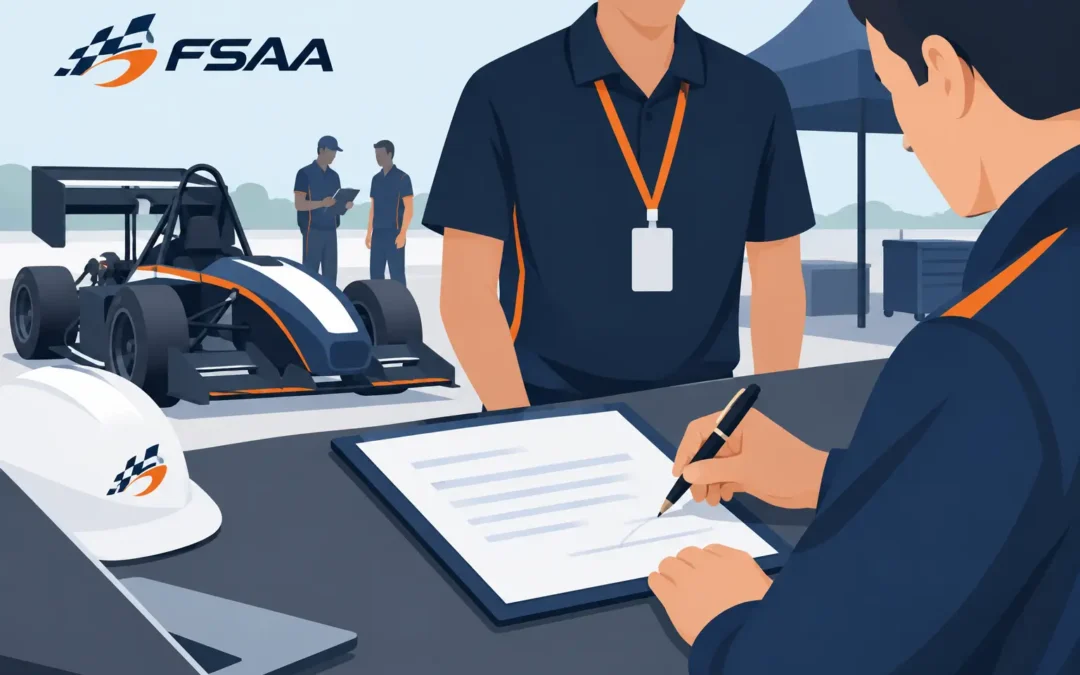
A completed compliance form is more than event paperwork. It is a team’s formal statement that the car presented in the paddock is the car that has been designed, checked, and made ready to meet the competition rules. So, who signs vehicle compliance forms? In Formula Student, the answer is usually not one person alone. The team provides accountable sign-off, while competition officials verify compliance through scrutineering.
That distinction matters. A signature from a student team does not certify that a car has passed technical inspection. It confirms that the people responsible for the vehicle stand behind the information submitted. The final authority on whether the car may compete rests with the appointed scrutineers and event officials, following the current rules and procedures.
Who signs vehicle compliance forms before scrutineering?
The exact signature fields depend on the competition, vehicle class, and current-year documentation. Always treat the latest event rules, forms, and official communications as the source of truth. Still, most Formula Student compliance paperwork follows a clear chain of responsibility.
The team captain or designated team representative commonly signs the overall declaration. This person confirms that the submission is accurate, that the team accepts the relevant regulations, and that the vehicle presented belongs to the registered team. This is an organizational commitment, not a substitute for technical expertise.
The technical lead, chief engineer, or vehicle responsible person typically signs technical declarations where the form requires confirmation of design or build compliance. They should be able to explain the car’s systems, show the supporting evidence, and coordinate the team during inspection. On a large team, this responsibility may be assigned to a dedicated compliance lead, but the named person must have real knowledge of the vehicle.
For specific systems, forms may require confirmation from the responsible subsystem lead. An electrical lead may be asked to verify accumulator, shutdown circuit, insulation, and wiring documentation for an electric vehicle. A combustion powertrain lead may confirm fuel, exhaust, and powertrain safety details. The person signing should not be chosen simply because they are available at registration. They should be able to defend the declaration with drawings, calculations, test records, and a physical walkaround of the car.
Finally, scrutineers and authorized event officials sign or record the inspection outcome where the procedure calls for it. Their approval indicates that the vehicle, as inspected, has met the required checks or that identified issues have been cleared. They do not take over the team’s responsibility for the build. They independently assess it.
A signature is an accountability chain
The strongest teams do not view compliance forms as a last-minute task for the captain. They build a traceable approval process before arriving at the track. Each signature should connect to evidence, a responsible person, and a clear version of the vehicle documentation.
A useful internal approach is to assign ownership early: the captain owns the final team declaration, the technical lead owns the whole-car review, and subsystem leads own the claims within their areas. Then hold an internal readiness review before submitting anything. This turns compliance from a stressful administrative checkpoint into an engineering quality gate.
For example, if an electrical form asks for a confirmation about a shutdown circuit, the electrical lead should have the current schematic, inspection record, and test result ready. If a technical lead signs that the car matches its submitted documentation, they should confirm that late garage changes have been reflected in the drawings and forms. A signature without that check can create delays that cost valuable time in the paddock.
There is a practical trade-off here. Requiring several internal approvals takes time, especially close to shipping or travel deadlines. But a rushed single sign-off can hide version mismatches, missing labels, or untested safety functions. The teams that move fastest through scrutineering are often the ones that invested more time before the event.
Team signatures versus scrutineer approval
It helps to separate these two moments clearly.
A team signature says: “We declare that this information is true and that we have met the stated requirements to the best of our knowledge.” A scrutineer approval says: “Based on the prescribed inspection, this vehicle or item is accepted for the next stage.”
Scrutineering is not a ceremonial stamp. Inspectors may ask for evidence, request a demonstration, identify nonconformities, or require changes before signing off. A team can arrive with perfectly completed forms and still need to correct an issue on the car. Equally, a technically strong car can be held up when documents are incomplete, unsigned, outdated, or inconsistent with the vehicle in front of the inspector.
This is why the signatory should be present, or immediately reachable, during technical inspection. If the person who signed a declaration cannot explain it, the team loses time finding answers. Bring the right people to the inspection lane: the captain or designated representative, the technical lead, and specialists for the systems most likely to require demonstration.
What a responsible signer should check
Before signing, the responsible person should verify more than a box on a form. They should confirm that the car’s identification, class, and team details are correct; that the document version matches the current event release; and that every required field, attachment, and date is complete.
They should also compare the paperwork to the actual car. Check component labels, accumulator or fuel-system details, safety equipment, firewall and cockpit condition, wheel and brake assemblies, electrical schematics, and any declared dimensions or specifications relevant to the form. The right checklist will vary by class and ruleset, but the principle stays the same: sign what you have personally verified or formally reviewed with the responsible engineer.
A final review should include the vehicle’s latest changes. Formula Student cars evolve rapidly during the final weeks before competition. A redesigned mounting bracket, changed inverter setting, replacement cell enclosure, or revised pedal assembly may be a legitimate improvement, but it can affect documentation. Record changes, assess their rule impact, and update the materials before a signer makes a declaration.
Common mistakes that create inspection delays
The most frustrating compliance issues are usually preventable. Teams often submit a form signed by a person who has not reviewed the final car, use an outdated template, or bring evidence that does not match the declared configuration. Another frequent problem is treating a subsystem signature as a whole-vehicle approval. Each signer needs to understand the boundary of their responsibility.
Avoid signing on behalf of someone else unless the event procedure explicitly permits a designated substitute. Do not leave dates blank or assume a digital upload eliminates the need for a physical signature if the event instructions require one. And do not alter a signed document after submission without recording the revision and following the event’s correction process.
At FS Alpe Adria, teams should prepare for compliance as they prepare for dynamic events: with ownership, practice, and respect for the details. The competition environment rewards ambitious engineering, but it also rewards teams that can demonstrate how their engineering is safe, documented, and ready to run.
Build compliance into the season
The best time to decide who signs vehicle compliance forms is at the start of the build season, not on the morning of scrutineering. Name a compliance owner, define technical signatories for major systems, and set internal document freeze dates before event deadlines. Keep one controlled folder for approved drawings, test records, declarations, and revision history so the team is not searching through personal laptops in the paddock.
When the car finally rolls toward inspection, the goal is not merely to collect signatures. It is to show the professional standard behind your team’s work. A clear declaration, backed by knowledgeable students and convincing evidence, gives scrutineers confidence and gives your team more time to do what it came to do: compete, learn, and prove what it can build.