


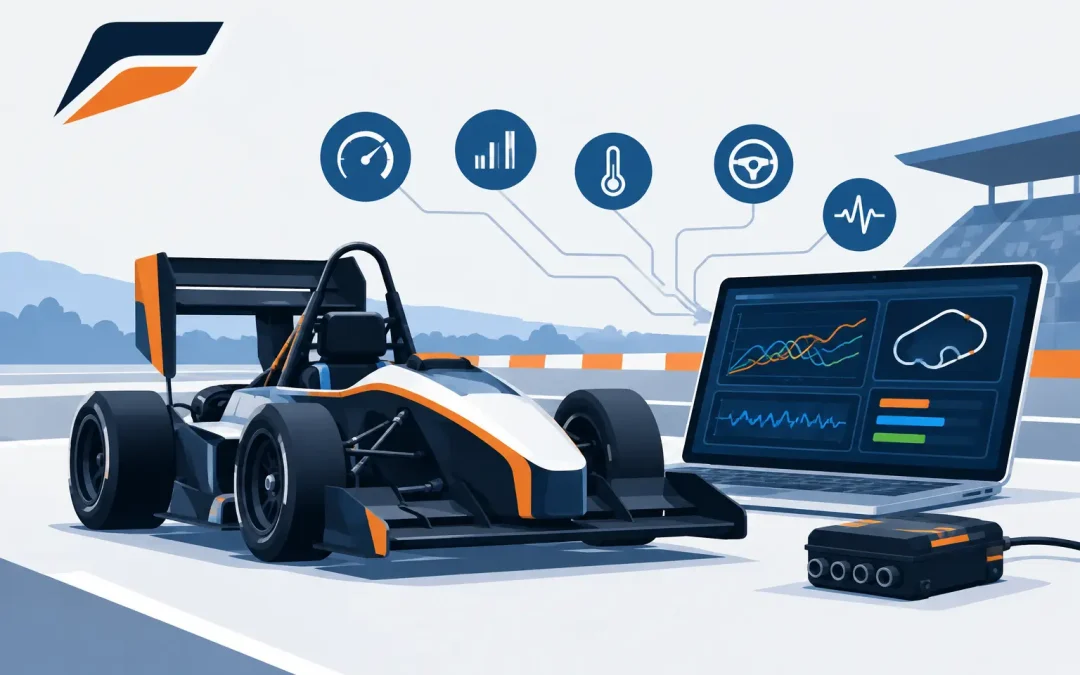
A driver returns from a promising run and says the car felt nervous on corner entry. That is useful feedback, but it is only the start of the conversation. Vehicle data tools help a Formula Student team turn that feeling into evidence: whether the rear unloaded under braking, whether wheel lock began before the apex, whether the tires were outside their working window, or whether the driver simply needed a different reference point.
For a student team, data acquisition is not about filling a dashboard with channels. It is about making better design and setup decisions with the time, sensors, and people available. A clean, trusted measurement taken at the right moment can save more development time than a complex system nobody can validate.
What vehicle data tools should do
The best vehicle data tools create a reliable chain from the car to the next action. They capture what happened, preserve enough context to explain why it happened, and present the result in a form that a vehicle dynamics lead, controls engineer, and driver can discuss together.
That chain usually begins with a logger and CAN data, then expands through sensors, video, analysis software, and disciplined test notes. The exact setup depends on the vehicle. An internal-combustion car may prioritize engine parameters, fuel pressure, temperatures, and drivetrain behavior. An electric vehicle may place greater attention on inverter limits, battery current, cell temperatures, isolation-related states, torque requests, and regenerative braking. Autonomous teams also need confidence in perception, localization, actuator commands, and system timing.
The common principle is the same: measure the signals that can change a decision. If a channel will not influence design, setup, reliability, driver coaching, or rules compliance, it may not deserve space in an already busy system.
Start with the questions, not the sensor catalog
Before purchasing hardware or adding another CAN message, define the questions your team needs to answer. During an early shakedown, the priority may be basic reliability: Is coolant temperature stable? Does the brake system retain pressure? Is the accumulator or fuel system behaving as expected? At a handling test, the questions become more specific: Where is time lost? Is the car traction-limited or power-limited? Does the balance change during a run?
This approach prevents a common Formula Student problem: collecting hundreds of channels with no agreed method for reviewing them. More data can create more uncertainty when sampling rates, units, timestamps, and sensor calibrations are inconsistent.
A practical core set often includes vehicle speed, wheel speeds, steering angle, brake pressures, throttle or torque request, yaw rate, longitudinal and lateral acceleration, and key powertrain or energy-system values. Suspension position, damper position, tire temperatures, tire pressures, GPS position, and video can add major value, but only when the team has the capacity to install, calibrate, and interpret them properly.
Build a measurement system you can trust
A fast data review is only valuable if the data is credible. Sensor accuracy is not enough. Teams also need to consider resolution, sample rate, sensor placement, noise, latency, electrical grounding, and whether every system uses the same time base.
Take wheel speed as an example. It can support traction analysis, braking analysis, and driver feedback, but it becomes misleading if one encoder has an incorrect tooth count, a loose mounting bracket, or a different filtering strategy. The graph may look polished while pointing the team toward the wrong fix.
Create a short validation routine before every test day. Check zero values with the car stationary, confirm steering calibration lock-to-lock, compare wheel speeds during a straight low-speed roll, inspect plausible pressure and temperature readings, and verify CAN messages against expected states. If the vehicle has GPS and video, confirm that their clocks line up with the logger before the first serious run.
Calibration should be treated as an engineering deliverable, not a task left for the morning of testing. Record sensor ranges, conversion equations, pinouts, firmware versions, coordinate conventions, and channel names in one accessible location. When a graduating student takes their knowledge with them, this documentation protects the next generation of the team.
Turn runs into useful comparisons
A single lap rarely gives a complete answer. Track conditions change, drivers improve, tires evolve, and confidence grows. The most effective analysis compares like with like: similar state of charge or fuel level, tire condition, ambient temperature, course configuration, and driver intent.
Overlaying runs is powerful when the question is narrow. Compare speed trace, steering angle, brake pressure, and throttle application through one section of the course. If one run gains time on entry but loses it on exit, the team can investigate whether braking was more effective, rotation was excessive, or earlier throttle created wheelspin. A lap-time delta shows where the result happened; the supporting channels suggest why.
Driver feedback belongs beside the traces, not below them. A driver may report instability while the data shows a repeatable increase in rear wheel speed variation under trail braking. That combination is far stronger than either source alone. It gives the team a testable direction, such as reviewing brake balance, rear rebound settings, differential behavior, torque control, or driving technique.
Video is particularly valuable here. It provides the visual context a channel cannot: bumps, cones, traffic, a correction at the wheel, or a moment when the driver avoided a curb. Synchronize forward-facing video with a data overlay whenever possible, but do not mistake an attractive overlay for analysis. The purpose is to support a question and a decision.
Use data to protect test time
Formula Student teams rarely get enough track time. A structured process ensures that every run has a purpose and that vehicle data tools serve the whole team rather than one specialist.
Before testing, define a hypothesis, the change being made, the success measure, and the person responsible for the decision. For example: reduce front rebound damping by a controlled amount, then evaluate whether the car maintains a more stable tire contact behavior over a known surface change without harming braking consistency. The team does not need to prove every theory in one session. It needs to run clear experiments.
After each run, complete a short debrief while the details are fresh. Note driver comments, faults, weather, tire pressures, setup changes, state of charge or fuel level, and any unusual event. A five-minute note can explain a confusing trace days later, when memory has become less reliable.
There is also a safety and reliability benefit. Trends in temperature, voltage, pressure, vibration, or fault frequency can reveal a developing issue before it becomes a trackside failure. Set sensible warnings, but avoid alarm fatigue. A warning system that triggers constantly will soon be ignored. Thresholds should reflect actual risk, expected operating behavior, and the team’s ability to respond.
Make analysis a team sport
The data lead should not become a gatekeeper who sends graphs after testing has ended. Strong teams build a shared review culture. The driver learns what a brake-pressure trace reveals. The mechanical group understands how a suspension sensor can expose compliance or ride-height changes. The electronics and controls groups can explain what a torque limit or fault state means in the context of vehicle behavior.
This does not mean everyone must become an expert in every tool. It means every discipline should know what evidence it needs and how to challenge an interpretation constructively. A graph is not a verdict. It is a measurement with uncertainty, collected under specific conditions.
At FS Alpe Adria, that mindset matters because the competition rewards more than raw pace. Teams must show that their vehicle is engineered, validated, and communicated with intention. Clear data practices support endurance preparation, design decisions, business discussions, and the confidence to explain trade-offs to judges, scrutineers, and industry professionals.
Choose progress over complexity
A well-integrated basic logger with accurate wheel speeds, steering, brake pressure, accelerations, and disciplined notes will often outperform an advanced system that is unfinished or poorly understood. Start with the signals tied to your largest risks and performance questions. Add capability when your team has a repeatable method for using it.
The trade-off is real. More sensors can reveal more of the car, but they add weight, wiring, failure points, cost, and analysis workload. Sampling faster may capture transient behavior, yet it also produces more files and can magnify noise. The right choice depends on the maturity of the car and the question in front of the team.
Bring a specific question to the next test, measure what can answer it, and write down what changed. That habit is where a collection of sensors becomes an engineering advantage – and where student teams build the judgment that carries far beyond a single competition season.